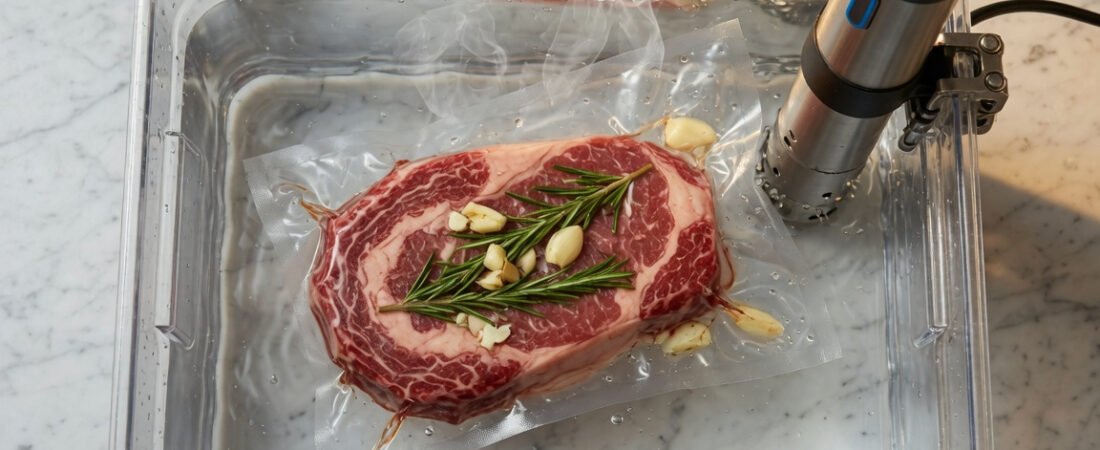
Sous vide (pronounced soo-veed) is a cooking method where food is sealed in a bag and cooked in precisely temperature-controlled water. It’s the technique behind every impossibly perfect restaurant steak — and in 2026, you can replicate it at home for under $100.
- Sous vide means “under vacuum” in French — food is sealed in a bag and immersed in a water bath held at an exact, constant temperature.
- Modern immersion circulators maintain water temperature to within ±0.1°F (±0.05°C), delivering a level of precision no conventional cooking method can match.
- The technique has been standard in Michelin-starred kitchens for over 50 years — and entry-level home setups now cost as little as $100.
- Because food cannot exceed the temperature of the water bath, overcooking is essentially impossible — the biggest single shift in how home cooks experience protein cookery.
What Does “Sous Vide” Actually Mean?
The phrase is French for “under vacuum,” which describes the original preparation step: sealing food in an airtight bag before it ever hits the heat. But the name only tells half the story. The real innovation is what happens next — immersing that sealed bag in water held at a single, unwavering temperature for the entire cook, with no fluctuation, no hot spots, and no guesswork.
The technique was pioneered in France in the mid-1970s. Chef Georges Pralus discovered that cooking foie gras this way preserved its texture, appearance, and flavour far better than traditional methods — and dramatically reduced the expensive shrinkage that plagued high-cost restaurant ingredients. Working alongside him, food scientist Dr. Bruno Goussault began building the food safety framework that would eventually make sous vide trusted and scalable in professional kitchens worldwide. Goussault’s research on time-temperature pasteurisation essentially gave sous vide its scientific legitimacy.
For nearly four decades, the technique stayed locked inside restaurant kitchens running specialist equipment that cost thousands of dollars. That changed around 2013 when the first consumer-grade immersion circulators reached accessible price points. By 2026, a capable home sous vide setup costs roughly $100–$150 — less than a single dinner for two at the kind of establishment that uses the technique every service.
How Exactly Does Sous Vide Cooking Work?
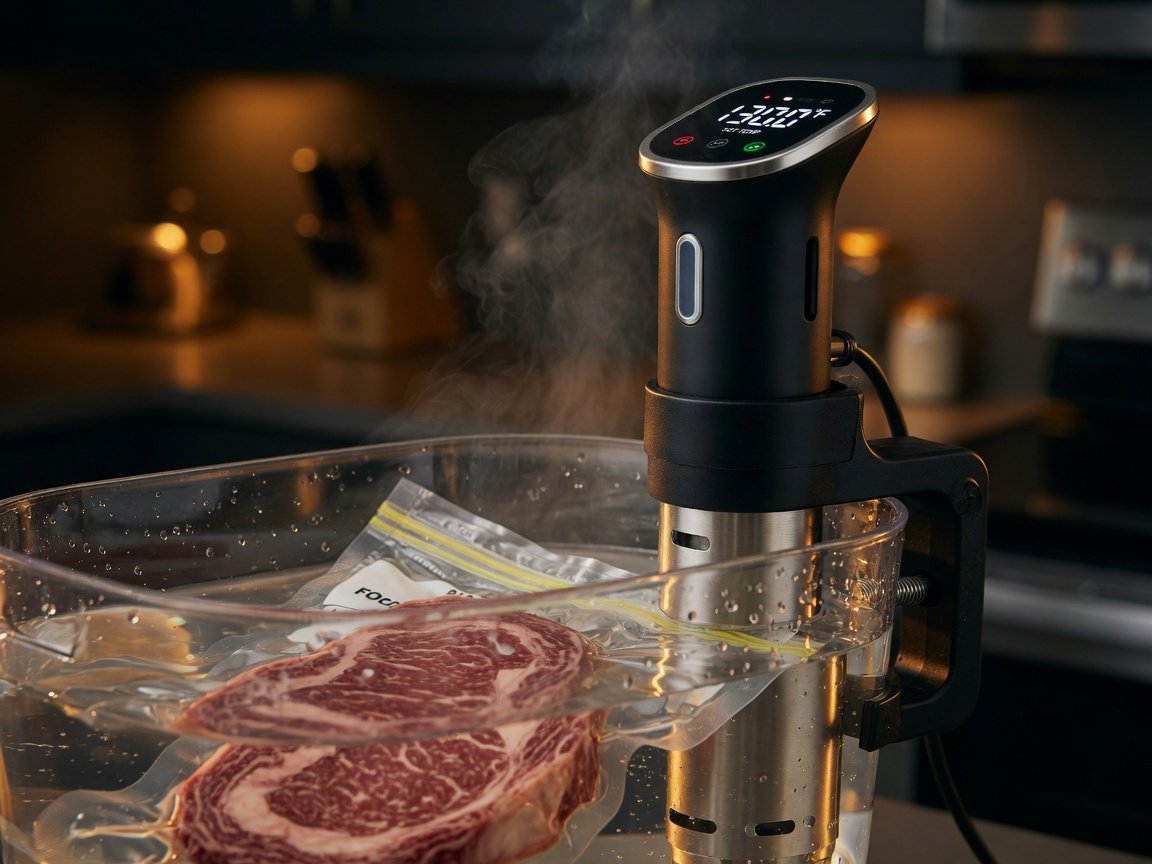
The physics are elegantly simple. Water is roughly 25 times more thermally conductive than air, which means it transfers heat to food far more efficiently and evenly than a conventional oven. Set a water bath to 130°F (54°C) for a medium-rare steak, and every millimetre of that steak eventually reaches exactly 130°F — then stops. It cannot go higher, because the water itself is no hotter than that.
An immersion circulator does two jobs simultaneously: it heats the water and circulates it continuously. Circulation prevents temperature pockets from forming around the bag, keeping the bath uniform from top to bottom. Modern circulators hold temperature to within ±0.1°F (±0.05°C) — a level of precision that no conventional cooking method, from cast iron to convection oven, comes anywhere close to matching. This is why sous vide results are so repeatable: the critical variable, internal temperature, is completely controlled.
Food safety in sous vide relies on the relationship between temperature and time rather than temperature alone. The USDA’s standard guideline of 165°F (74°C) for poultry is written for instant-kill scenarios. But pasteurisation is a cumulative process — research in food science clearly documents that holding chicken at 140°F (60°C) for 30 minutes achieves the same 7-log reduction in salmonella as instantaneous exposure to 165°F. This is why properly executed sous vide chicken can be cooked at temperatures that would look dangerously underdone by conventional standards, yet be fully safe to eat.
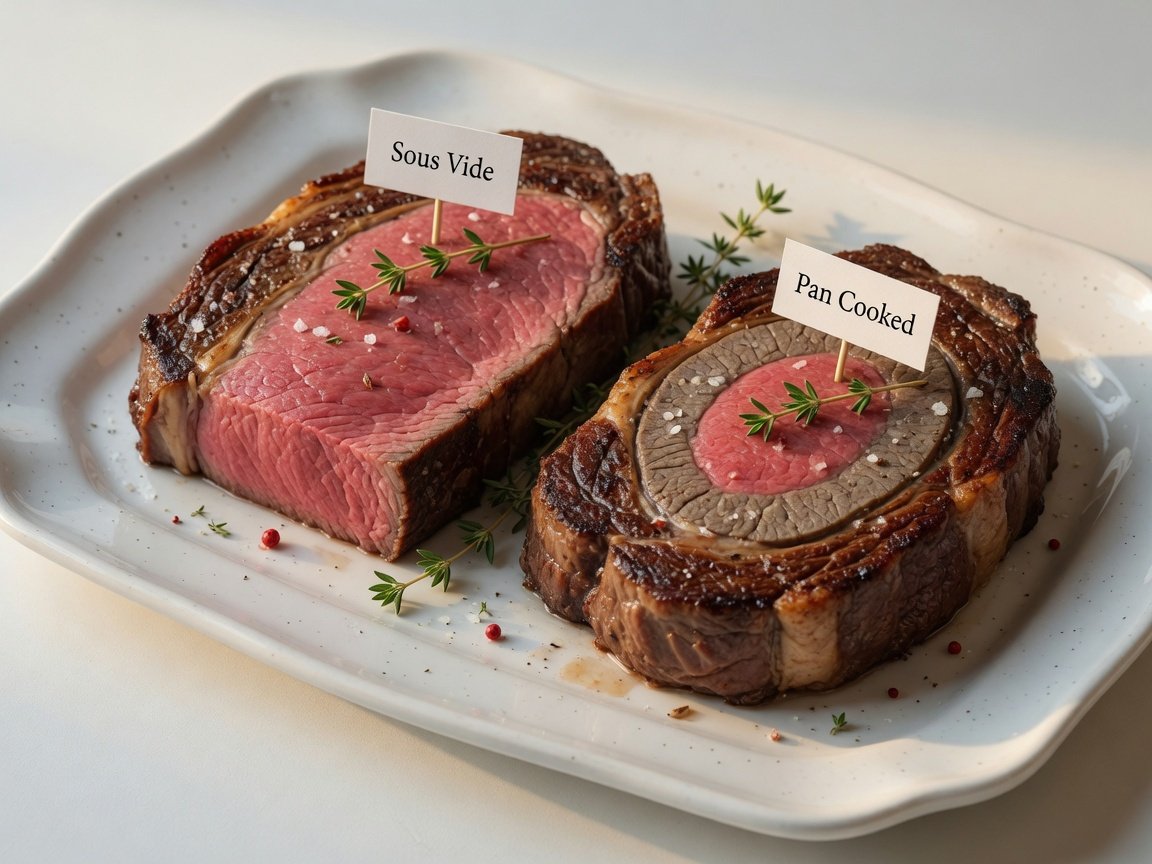
Once the bag comes out of the bath, most foods need a quick finishing step. The Maillard reaction — the browning that creates crust, roasted flavour, and visual appeal — requires surface temperatures above 300°F (150°C), which a water bath cannot produce. A cast iron pan or kitchen torch does the job in 60–90 seconds per side. That brief, fierce sear completes the dish and is the step that elevates sous vide from merely precise to genuinely spectacular.
What Equipment Do You Need to Get Started?
You need considerably less than you might expect. Most home kitchens already have everything except the circulator itself. Here is what a complete, functional sous vide setup looks like in 2026:
Your Complete Sous Vide Starter Kit
- Immersion circulator — The core device. Clamps to any pot, handles both heating and water circulation, and displays your target temperature. Entry-level models from well-regarded brands are widely available under $100; mid-range options ($100–$200) add quieter motors, Wi-Fi connectivity, and companion apps.
- A deep cooking vessel — Any large stockpot works well for most cooks. A 12-litre polycarbonate food container is a popular upgrade: transparent, heat-safe, and easy to check on. For long cooks lasting eight hours or more, an insulated container or a neoprene sleeve reduces heat loss and saves on electricity.
- Bags — Zip-lock freezer bags are genuinely excellent for most sous vide cooking. Use the water displacement method (submerge the open bag until water pressure pushes out the air, then seal) to remove air without a vacuum sealer. A vacuum sealer is a worthwhile upgrade for liquid-heavy recipes, delicate fish, or anyone cooking sous vide multiple times per week.
- A finishing surface — A cast iron skillet, carbon steel pan, or outdoor grill, preheated as aggressively as possible. Some cooks prefer a dedicated kitchen torch for an even, controlled sear. The sear adds the Maillard crust that completes the dish in 60–90 seconds per side.
- A probe thermometer (optional) — Your circulator monitors the water temperature. A probe thermometer is a useful secondary check when cooking unusually thick cuts or experimenting with new recipes where you want to confirm the centre has reached your target.
The total cost of entry — circulator, a vessel you may already own, and a box of zip-lock bags — sits comfortably around $100–$150. That is a one-time investment that pays back in restaurant-quality results from the very first cook. If you want to get a feel for how wide the technique’s reach actually is, discovering everything sous vide cooking has to offer is a great next step once you have your first session under your belt.
What Are the Biggest Benefits of Sous Vide Cooking?
Sous vide isn’t just a gadget. It solves concrete, recurring problems that home cooks face every time they put a protein in a pan. Here are the benefits that keep people reaching for the circulator instead of the frying pan.
Consistency you can actually rely on
Once you find a time and temperature combination that works, you can reproduce it exactly — whether you are cooking for two on a Tuesday evening or feeding a dinner party of twelve on a Saturday. Conventional cooking doesn’t offer that guarantee. Oven calibration varies, pan thickness affects heat transfer, and a moment’s distraction changes everything. Sous vide removes those variables completely.
Overcooking becomes essentially impossible
Food in a 130°F (54°C) bath will reach 130°F and stop there — whether you retrieve it at the 1-hour mark or 3 hours later. This transforms the cooking window from a narrow, stressful target into a generous range. Dinner guests running 45 minutes late is no longer a kitchen crisis. The food simply holds, perfectly, until you are ready.
Hands-off, flexible timing
Most sous vide proteins can hold safely in the water bath for 2–4 hours beyond their minimum cook time without any quality loss. Set the circulator going, prepare your sides, lay the table, or step out entirely. The device does the work. You return when you are ready, pull the bag, sear for 90 seconds, and serve. There is no other cooking method that gives you this much freedom over timing.
Better nutrition and less food waste
Cooking in a sealed bag keeps all juices, water-soluble vitamins, and minerals locked inside the food rather than losing them to evaporation or a pan. Food science research on low-temperature sealed cooking consistently demonstrates better retention of heat-sensitive nutrients compared with high-heat methods. And because overcooked proteins are practically eliminated, expensive cuts are never wasted on a moment’s inattention at the stove.
What Foods Can You Actually Cook Sous Vide?
The honest answer is: almost everything. Some categories, however, produce results that are genuinely impossible to achieve any other way.
Proteins — where sous vide truly excels
Steak, chicken breast, pork tenderloin, salmon, duck breast, lamb rack, and short ribs all benefit enormously from precise temperature control. Chicken breast cooked at 140°F (60°C) for 90 minutes is consistently juicier and more tender than anything a pan or oven can produce — because the proteins never reach the temperature at which they begin contracting and squeezing out moisture. The textural improvement on a simple chicken breast alone converts most first-time sous vide cooks permanently.
Eggs — a sous vide revelation
Eggs are one of the most popular entry points to sous vide, and for good reason. The difference between a 63°C egg and a 65°C egg is dramatic: two degrees shifts the yolk texture from silky-runny to jammy to fully set. No other cooking method gives you that granular control over egg texture. Japanese onsen tamago (hot-spring eggs) — with their custard-like whites and flowing golden yolks — are virtually impossible to replicate without sous vide.
Vegetables — concentrated and intense
Root vegetables cooked at 185°F (85°C) develop a sweetness and depth that steaming or roasting rarely matches. Carrots, beets, parsnips, and corn on the cob are standouts. Because the bag traps every drop of released moisture and flavour compound, there is no dilution — everything that comes out of the vegetable stays right there in the bag, coating each piece.
Desserts and infusions
Custards, crème brûlée, and cheesecakes cook beautifully in jars set in a sous vide bath. Flavoured oils and spirits infuse in 1–2 hours at 130°F–150°F (54°C–65°C) — achieving what cold infusion takes weeks to accomplish. It is a quietly powerful tool for anyone who enjoys making cocktails or flavoured oils at home.
What doesn’t work well
Anything that depends on dry heat for texture — crispy-skinned chicken, roasted potatoes, bread — won’t benefit from a water bath. Dishes where the browning IS the cooking (deeply caramelised onions, a pan sauce) don’t translate. Pasta and rice need special handling. For virtually everything else, the answer is yes.
How Does Sous Vide Compare to Traditional Cooking Methods?
Understanding what makes sous vide different is easier when you put it side by side with the methods you already know. Here is how it stacks up across the dimensions that matter most to a home cook:
| Factor | Sous Vide | Pan / Stovetop | Oven | Grill |
|---|---|---|---|---|
| Temperature precision | ±0.1°F — exact | Variable, hard to control | ±25°F typical | Very variable |
| Overcooking risk | Essentially zero | High — narrow window | Moderate | High |
| Hands-on time required | Very low — set and walk away | High — constant attention needed | Low to moderate | Moderate — must attend |
| Browning and crust | Requires a finishing sear | Excellent | Good (surface only) | Excellent |
| Repeatability | 100% — identical result every time | Skill-dependent | Good once dialled in | Variable |
| Active cook time | Longer — typically 1–48 hours | Fast — minutes | 30 minutes to 6 hours | Fast — minutes |
| Entry cost | ~$100 setup | Pan you already own | Built into kitchen | $50–$500+ |
Is Sous Vide Cooking Actually Safe?
Food safety is the most common concern among new sous vide cooks — and it is a fair one. Cooking chicken to 140°F instead of 165°F, or steak to 130°F, looks wrong when you have spent years following conventional guidelines. But those guidelines are written for instant-kill temperature scenarios. The science of pasteurisation is considerably more nuanced.
The USDA’s 165°F guideline for poultry is the temperature at which salmonella dies instantaneously. But bacteria die at lower temperatures too — it simply takes longer. Hold chicken at 140°F (60°C) for 30 minutes, and the cumulative heat exposure achieves the same 7-log reduction in pathogen load as instantaneous exposure to 165°F. This is well-established food science, documented extensively in peer-reviewed research on time-temperature pasteurisation — and it is the framework used in HACCP plans in professional kitchens worldwide.
There are important caveats to observe. Extended low-temperature anaerobic cooking — meaning in a sealed bag at temperatures below 130°F (54°C) for longer than 4 hours — creates conditions where Clostridium botulinum could theoretically proliferate. For long cooks, the established safe thresholds are 130°F or above for beef and 140°F or above for poultry. Those who are pregnant, elderly, or immunocompromised should follow conservative food safety guidelines and consult relevant health guidance for their specific situation.
How Long Does Sous Vide Cooking Take?
Cook times are measured in hours rather than minutes — not because the food is slow to cook through, but because the extended window is one of sous vide’s most practical features, and because longer holds often produce measurably better texture. Minimum times represent when the food reaches safe temperature throughout the centre. Maximum useful times represent the point before texture begins to degrade. In between, you have a generous, flexible window.
Here are the key benchmarks most home cooks work with on a regular basis:
| Food | Temperature | Minimum Time | Sweet Spot | Maximum Hold |
|---|---|---|---|---|
| Steak (medium-rare) | 130°F / 54°C | 1 hour | 1.5–2 hours | 4 hours |
| Chicken breast | 140°F / 60°C | 1 hour | 1.5–2 hours | 4 hours |
| Salmon fillet | 122°F / 50°C | 40 minutes | 45–60 minutes | 90 minutes |
| Pork tenderloin | 140°F / 60°C | 1 hour | 1.5–2 hours | 4 hours |
| Duck breast | 135°F / 57°C | 90 minutes | 2–3 hours | 4 hours |
| Egg (63°C soft-boiled style) | 145°F / 63°C | 45 minutes | 45–60 minutes | 75 minutes |
| Carrots / root vegetables | 185°F / 85°C | 1 hour | 90 minutes | 3 hours |
| Short ribs | 135°F / 57°C | 24 hours | 48–72 hours | 72 hours |
The practical implication of these windows is significant. Drop a chicken breast into the bath before you leave for work, and it is ready to sear when you get home. Set short ribs on a Friday evening, and they are ready for Sunday dinner. The cook time is, almost entirely, time you don’t need to spend in the kitchen.
A Real-World Example: What Sous Vide Looks Like in Practice
The proof of sous vide isn’t in theory — it’s in measurable, repeatable kitchen outcomes. One of the most thoroughly documented examples in the culinary world is at The French Laundry in Napa Valley, California.
📊 Case Study: The French Laundry, Napa Valley
Chef Thomas Keller’s three-Michelin-star restaurant has used sous vide as a cornerstone technique for decades. Keller has publicly credited the method — most notably in his 2008 book Under Pressure — with enabling the kitchen to produce consistent, exacting results across multiple seatings every service, something that would be impossible with the inherent variability of conventional high-heat cooking.
Key documented outcomes at The French Laundry:
- Protein shrinkage significantly reduced compared with pan-only cooking, because lower bath temperatures and sealed bags retain moisture that high-heat methods drive off.
- Consistent doneness across every plate of a multi-course tasting menu, regardless of how many covers are being served simultaneously — a precision standard that kitchen brigades simply cannot maintain by feel alone at volume.
- Extended safe holding times that allow kitchen timing to be managed with a precision unavailable through conventional cooking, reducing service pressure and improving plate consistency from the first cover to the last.
- Under Pressure, Keller’s codification of sous vide technique for professional use, remains a reference text in culinary programmes worldwide more than 15 years after publication.
The principle scales directly to the home kitchen — the physics are identical. A home cook with a $100 circulator has access to the same temperature precision as a three-Michelin-star restaurant kitchen.
What makes this case study instructive is not the restaurant setting — it is the underlying principle. Precision is the equaliser. When the water bath handles the most consequential variable, internal temperature, the cook’s skill matters less for the outcome and more for everything else: seasoning, timing, creativity, and presentation.
What Are the Downsides of Sous Vide Cooking?
Sous vide has real limitations, and being clear about them is more useful than overselling the technique. Here is what to know before you buy in.
It requires planning ahead
Most sous vide proteins require a minimum of 1–2 hours. This makes sous vide ideal for meal prep and planned dinners, but it is not the answer when you decide at 6:30pm that you want steak on the table at 7:00pm. For spontaneous cooking, a very hot cast iron pan is still your best tool. Sous vide rewards the cook who thinks a few hours ahead.
You always need a finishing sear
Sous vide produces precisely cooked interiors with no exterior colour at all — the food comes out of the bag looking pale and unappetising. Almost every protein requires a post-bath sear to develop the Maillard crust that makes food look and taste like food. This is a quick step, but it requires a screaming-hot surface and creates smoke. First-time cooks who skip the sear — or don’t get the pan hot enough — wonder why their perfectly cooked steak looks like boiled meat.
Liquids and delicate proteins need care
Zip-lock bags handle most home sous vide tasks well, but liquid-heavy marinades can compromise the seal if they splash into the zip closure. Delicate fish like salmon cooks quickly and can overcook — 40 minutes at 122°F (50°C) is about right, and leaving it 3 hours past that will degrade the texture noticeably. The forgiving hold window that makes steak easy also makes salmon a recipe to pay attention to.
Counter space during long cooks
A circulator itself is compact, but a large water vessel running for 48 hours takes up meaningful counter space. In a tight kitchen, managing a 12-litre container through a multi-day cook around other food prep is worth planning for before you commit to the technique for a big event.
Where Is Sous Vide Heading in 2026 and Beyond?
The technique has been mainstream in restaurant kitchens for decades and a genuine home kitchen option for over a decade. But 2026 sees the category evolving quickly in several interesting directions.
Smarter, connected devices as standard
The leading immersion circulators in 2026 connect to smartphone apps that provide remote monitoring, guided recipe programmes, and automatic temperature scheduling. Wi-Fi connectivity has moved from premium feature to baseline expectation at entry price points. You can now start a 2-hour chicken cook from your commute home and receive a push notification when it is time to sear.
AI-assisted recipe personalisation
App ecosystems around sous vide circulators increasingly use AI to personalise time-temperature recommendations based on the actual thickness, starting temperature, and weight of your specific piece of protein — not a generic chart. Rather than looking up a time for “chicken breast,” you photograph or weigh it, and the app adapts. Several manufacturers launched this capability in 2025 and are refining it through 2026.
All-in-one combined appliances
Multiple appliance manufacturers have introduced self-contained sous vide vessels with integrated heating and circulation that eliminate the need for a separate pot entirely. These all-in-one units are quieter, neater, and easier to store than a circulator-plus-container setup. Expect this form factor to grow significantly as manufacturers compete on convenience and kitchen aesthetics through 2026 and 2027.
Mainstream adoption following the air fryer curve
Industry observers tracking kitchen appliance categories note that precision cooking is among the fastest-growing segments, driven by cooking content on social platforms and a sustained post-pandemic shift toward restaurant-quality home dining. By 2027, sous vide is widely expected to follow the adoption trajectory of the air fryer: from enthusiast niche to mainstream kitchen staple found in a significant proportion of engaged home kitchens.
Frequently Asked Questions About Sous Vide
Do I need a vacuum sealer to cook sous vide?
No. Zip-lock freezer bags work well for the vast majority of sous vide recipes. Use the water displacement method: submerge the unsealed bag in the water bath until water pressure pushes out almost all the air, then seal. A vacuum sealer is a useful upgrade for liquid-heavy recipes, fish, or frequent users, but it is absolutely not required to get started or to get excellent results.
Can sous vide cooking make you sick?
Not when used correctly. The time-temperature relationships in sous vide achieve the same pasteurisation standards as conventional cooking — they just operate differently. The key is following established guidelines for minimum temperatures and hold times: chicken at 140°F (60°C) for at least 30 minutes, beef at 130°F (54°C) for 2+ hours. Follow trusted sous vide guidance and you are cooking as safely as with any other method. Those who are pregnant, elderly, or immunocompromised should follow conservative food safety guidelines.
Can I leave sous vide food cooking overnight?
Yes, for appropriate recipes. Long-cook items like short ribs, pork shoulder, or lamb shoulder are routinely cooked for 24–72 hours at 135°F (57°C) or above. Your circulator will maintain the temperature safely throughout. Make sure your container has sufficient water depth that it won’t run low overnight, or use an insulated vessel with a lid to minimise evaporation. Overnight cooks are one of sous vide’s most practical features for stress-free entertaining and weekly meal prep.
Does sous vide food actually taste different?
It tastes more intensely of itself — because nothing is lost. All the juices, flavour compounds, and dissolved seasonings stay sealed in the bag throughout the cook. The result is noticeably more flavourful than the same protein cooked by other methods. What sous vide doesn’t produce on its own is the roasted, caramelised depth of the Maillard reaction — that’s what the finishing sear contributes. Together, the two steps produce the best of both cooking worlds.
Is sous vide worth it for a home cook?
For anyone who cooks proteins at home more than once or twice a week, yes — without hesitation. The initial investment is around $100–$150, and the improvement on chicken breast, steak, salmon, and pork alone justifies it many times over within the first few weeks. The learning curve is minimal compared to most other cooking techniques, and the consistency benefit compounds with every single use. Once most home cooks try it, they don’t go back.
What’s the difference between an immersion circulator and a sous vide machine?
“Sous vide machine” usually refers to an immersion circulator — a wand-style device that clips to any container you choose. Some manufacturers use the term to describe a self-contained all-in-one unit that includes both the heating element and the water container. Either type produces equivalent cooking precision and quality; the choice is about convenience, counter space, and personal preference rather than results.
Do restaurants actually use sous vide?
Extensively. Sous vide has been standard practice in fine dining for more than 30 years and is used broadly in hotel restaurants, high-end catering operations, and many mid-tier establishments that need to produce consistent results at volume. In a professional context, sous vide is less a premium technique and more a standard production tool — the kind of thing a kitchen brigade simply expects to have available, the same way they expect a commercial oven or a good set of knives.
Ready to Try Sous Vide? Here’s Where to Start
Sous vide is one of those rare cooking techniques that delivers immediately and keeps delivering. Your first sous vide chicken breast will almost certainly be the best chicken breast you have cooked at home. Your tenth will be just as good. That is the point — and that reliability is what makes the technique genuinely transformative rather than just a novelty.
Getting started doesn’t require a big commitment or a steep learning curve. Here is a simple five-step sequence to make your first cook a success:
- Choose a forgiving first recipe — A thick chicken breast or a 1.5-inch ribeye steak are ideal. Both produce dramatic improvements over conventional methods and teach you the fundamental process cleanly.
- Set your temperature before everything else — 140°F (60°C) for chicken, 130°F (54°C) for medium-rare steak. Preheat the bath for 15–20 minutes before the bag goes in.
- Season generously inside the bag — Salt, pepper, a smashed garlic clove, and a sprig of fresh thyme are all you need. The sealed environment concentrates flavour without any extra effort on your part.
- Plan the sear before the bag comes out — Get your cast iron pan as hot as it will go. Pat the protein completely dry the moment it leaves the bag. Sear 60–90 seconds per side. This step is non-negotiable — don’t skip it.
- Serve immediately — Unlike conventionally cooked meat, sous vide proteins don’t need a long rest. They have already cooked slowly and evenly throughout. Plate straight from the sear.
Once you have the fundamentals, the depth of what sous vide can do opens up quickly. From 48-hour short ribs to silky custards to intensely sweet root vegetables, the method adapts to almost any direction you want to take it. For a thorough guide to building your technique and going well beyond the basics, working through the full principles and techniques of sous vide cooking is an excellent next step once that first cook is behind you.
The sous vide community in 2026 is active, welcoming, and full of home cooks who started exactly where you are now. The equipment is affordable, the results arrive quickly, and that first moment when a perfectly pink, impossibly juicy chicken breast slides out of the bag — knowing you achieved it without any stress, any guesswork, or any wasted food — is genuinely exciting. Start simple. Cook it once. You will understand immediately why this technique has been a professional kitchen standard for 50 years.